

Headwind #3: When the Enrollment Process Works Against You
Empowered Enrollment Team
You didn’t plan to spend your enrollment season reacting to your calendar. But somehow, your days fill up fast: responding to inquiries, juggling applications, managing family interviews, answering the same questions in slightly different ways. None of it is wrong work, but it can leave you feeling like you’re operating one step behind, even when you know what’s coming next.
This tension surfaced in The Four Headwinds Fighting Your Enrollment Team, a Tassel webinar featuring Andy Lynch, President & CEO at Tassel, alongside Rudi Gesch, Director of Marketing, and Dan Quist, Director of Admissions at Timothy Christian Schools. Together, they named the headwinds (or unseen forces) that work against enrollment teams, even when schools are doing many things right.
As we shared in Headwind #1 (Lack of Role Clarity) and Headwind #2 (Team Readiness), these headwinds are structural realities baked into how enrollment work is defined, supported, and resourced in schools.
Headwind #3 is Clunky Logistics. Even strong teams with clear intent get stuck when calendars and processes aren’t designed to support strategy. This headwind shows up as reactivity, stress, and constant catching up, because the system itself isn’t clear.
Defining Logistics (It’s Not Software or Tools)
When enrollment teams talk about logistics, it’s easy for the conversation to jump straight to tools (systems, platforms, spreadsheets, etc.). But that’s not where most logistical breakdowns actually happen.
In the context of enrollment work, there are countless things that could fall under the umbrella of logistics. For this headwind, the panelists focused on the processes that guide families from first awareness to enrollment, as well as two areas where logistics often slow teams down (the admissions calendar and the marketing budget). When these lack clarity, everything else becomes harder to manage.
At its core, this headwind shows up when schools don’t have a common answer to some basic questions:
- What happens when?
- What comes next?
- Why does this step exist?
Without a clear admissions calendar, a defined sequence of steps, and shared understanding across the team, enrollment work becomes dependent on individual memory instead of collective clarity. Processes live in people’s heads, knowledge gets siloed, and even experienced teams find themselves reacting to the day instead of setting the pace.
You could be doing great work, but if logistics turn clunky, or the system isn’t clear, productivity becomes nearly impossible, no matter how committed or capable the people doing the work may be.
Why Logistics Matter: The Family Experience
Families don’t move from “marketing” to “admissions” to “enrolled” in neat stages. They move through questions, doubts, hopes, and tradeoffs (often all at once!). There are motivations driving families to your school. Once they find you, they’re trying to picture their child in a new environment. They’re weighing finances. They’re deciding if the drive is doable, if your philosophy aligns with theirs, if their child’s potential is going to be nurtured.
Logistics shape how families experience your school.
When timelines are unclear, follow-up is inconsistent, or next steps feel murky, it doesn’t just put a strain on your team. Families notice. They’re not looking for perfection, but uncertainty in the process adds weight to an already heavy decision. Every unanswered question or confusing handoff asks families to carry more of the process themselves.
That’s the hidden cost of clunky logistics. It creates extra emotional labor for families at the very moment they’re deciding whether your school is the right place for their child.
Clear, intentional logistics do the opposite. They help families feel guided rather than rushed, and supported rather than sold to. As a result, confidence grows because families can see that your school has thought carefully about how to walk them through this decision. Trust is built through the experience itself. When logistics are aligned, families don’t have to guess what comes next. They can focus on the question that matters most: Is this the right school for our child?
Two Areas Where Logistics Commonly Slow Teams Down
1. The Admissions Calendar
For many enrollment teams, the admissions calendar exists, but only in pieces. Key dates live in different places. Some are written down while others are remembered. A few resurface only when a deadline is suddenly right in front of you.
Your admissions calendar should be viewed as more than a list of dates. When you use it as a strategic tool, it can help your team shape the year (not just survive it).
A valuable exercise is to sit down together as a team and map the full admissions cycle by month. Name the deadlines, the enrollment windows, and the moments when pressure tends to peak. This doesn’t have to be perfect, or an exhaustive list, but it should help you to see the whole picture at once.
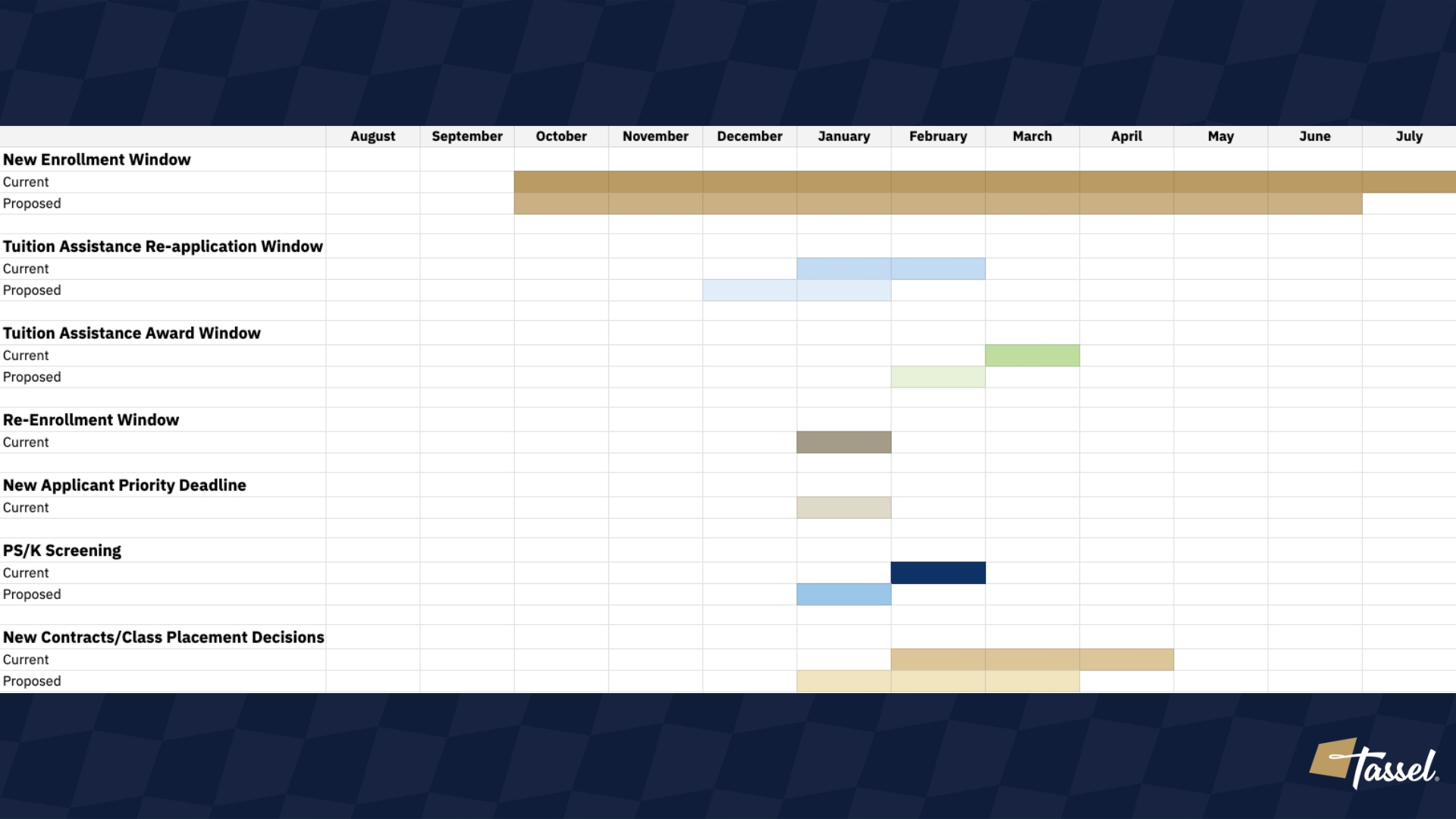
When teams take the time to map the full cycle, patterns emerge. You can see where multiple deadlines stack on top of one another, and when the pace shifts from steady to intense. You can see where your “sprint” actually lives, and just as importantly, where it doesn’t.
Without that clarity, enrollment work has a way of feeling like one long, continuous push. Busy seasons blur together, preparation gets crowded out by urgency, and the calendar becomes something you react to instead of something you use.
If your team knows the sprint is coming, you can prepare for it. The busiest stretches will still be demanding, but they’ll no longer be surprising. The calendar starts doing what it’s meant to do: support strategy, not interrupt it.
2. The Budget Process
The budget process is often treated as a financial conversation. In reality, it’s a logistics issue.
If an enrollment and marketing budget is unclear or approved one project at a time, it impacts a team’s ability to make progress on their goals. The work becomes fragmented, and planning shrinks from long-term possibilities to the next request as strategy gives way to permission-seeking.
This kind of project-based budgeting creates drag. Instead of asking, What does this season require? teams are left asking, Can we do this? Energy gets spent justifying decisions rather than making them, and autonomy erodes — even for experienced leaders who know what their school needs.
A defined budget range changes the dynamic.
Stability is gained when teams have a clear understanding of what’s resourced and what’s realistic. They no longer have to renegotiate decisions every time a need arises, because they’re supported to think long-term. Instead of reacting to gaps as they appear, teams can plan for the full enrollment cycle with intention.
Clear resourcing doesn’t remove constraints, but it does remove guesswork. That clarity allows enrollment teams to work proactively instead of episodically — building momentum over time rather than resetting with every new project or request.
Reflection: Where Might Logistics Be Creating Drag?
Clunky logistics can be a challenging headwind for your team to fight against, because more often than not they show up as low-level friction. They can even feel normal because they’ve been in place for so long.
Take a moment to pause and step back and look at the system supporting your enrollment work. These questions can be helpful to reflect on individually or with your team:
- Do we share a clear understanding of our full admissions cycle, or does that clarity live in the head of one person?
- Where does our enrollment work feel most reactive?
- What parts of our process rely more on memory than documented clarity?
- Where might families feel uncertainty, confusion, or unnecessary pressure?
- If families do feel friction points in the admissions cycle, how would we know?
Naming where drag exists is the first step toward creating the clarity that strategy depends on.
What to Do Next
Clunky logistics are more common than most teams realize, but they’re fixable! Consider stepping back and map what’s actually happening across your admissions cycle. Notice where work feels reactive, where families might feel uncertain, and where a lack of shared understanding creates drag. If you’re looking for someone to help you untangle it, we’d love to continue the conversation. A Tassel solutions advisor would be glad to listen to the specific challenges you’re facing and help you pursue the next steps towards healthy enrollment.