
5 Ways Smart Enrollment Teams Are Using AI
Empowered Enrollment Team
There’s no shortage of conversation about AI. What’s harder to find is clarity around where it can actually make a difference for your enrollment team. Because when you’re trying to meet enrollment goals with limited time and a long list of competing priorities … the questions get a lot more practical.
Can AI help you respond to prospective families faster? Turn more website visitors into inquiries? Personalize communication without adding hours of work to your team’s plate? And, perhaps most importantly, which AI tools are actually worth your time and investment?
We’re glad you asked, because AI can help when put to work in the right places. Here are five ways that smart schools can put it to work.
1. Turn more website visitors into inquiries
You may already be investing time and budget into getting prospective families to your website. But traffic alone won’t support enrollment if families browse a few pages and leave without letting who you know they are.
One challenge is that most school websites offer the same experience to every prospective family, even though those families arrive with very different questions. A parent exploring kindergarten may be looking for something entirely different from a parent considering high school. And a family early in their search may not be ready to fill out a traditional inquiry form at all.
AI-powered conversion tools can create a more relevant path forward. Tassel AI-Convert™, powered by Halda, uses AI-driven personalization to surface information based on how families interact with your website, helping them find content that matters to them and giving them opportunities to engage earlier in their decision-making process.
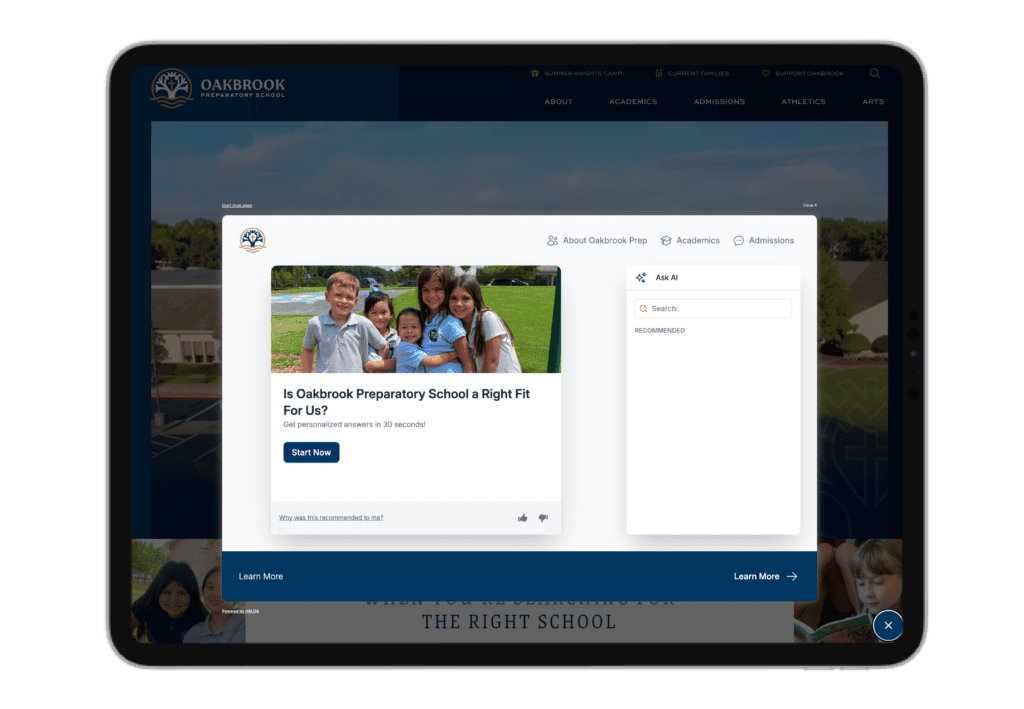
Think of it as adding more ways for prospective families to raise their hands. Rather than relying on one generic inquiry form, an AI-powered capture window can meet families with a next step that better reflects what they’re looking for. That creates another opportunity to turn the website traffic you already have into real enrollment conversations.
Your next step: Before you spend more to bring additional traffic to your website, take a close look at what happens to the families who are already there. Improving conversion may be one of the smartest places to start.
2. Respond to prospective families faster
A prospective family sends a question at 7:30 p.m. Your admissions team sees it the next morning, right alongside campus tours, applications, emails and everything else competing for their attention. You can’t be available around the clock. But AI can help reduce the time between a family asking a question and getting the response they need.
The key is knowing what to automate and what still needs a person.
AI can help with the work surrounding the conversation: drafting responses to common questions, summarizing inquiries, routing requests to the right person or preparing follow-up emails for your team to review. It can also help staff locate information faster, so they spend less time searching and more time responding.
Of course, some conversations deserve more than speed. A parent weighing whether your school is the right fit for their child, raising a sensitive concern or working through a major enrollment decision needs the judgment and empathy of someone who knows your school.
Think of AI as a way to shorten the distance between a family’s question and your team’s response, not remove your team from the conversation. When AI handles some of the prep work, your admissions team has more capacity for the conversations where being human matters most.
Your next step: Look at the questions and follow-up tasks that routinely take up your admissions team’s time. Where could AI help with the prep work while keeping your team at the center of the conversation? Use AI to shorten the distance between a family’s question and your team’s response, not to remove your team from the conversation.
3. Personalize family communication at a scale your team can actually manage
Families can tell when an email could have been sent to anyone. But as inquiry volume grows, writing every message from scratch for every family isn’t realistic either. This is an area where AI can give your admissions team a useful head start. Instead of asking it to write another generic admissions email, give it context about the family and where they are in their enrollment journey.
After a campus visit, for example, AI can help adjust an existing follow-up based on what a family shared while they were there. You could create a version of an email that speaks more directly to a family interested in athletics or faith formation. Or use questions from an earlier conversation to prepare a more relevant response without starting from a blank page. The quality of those drafts depends heavily on what you give AI to work with.
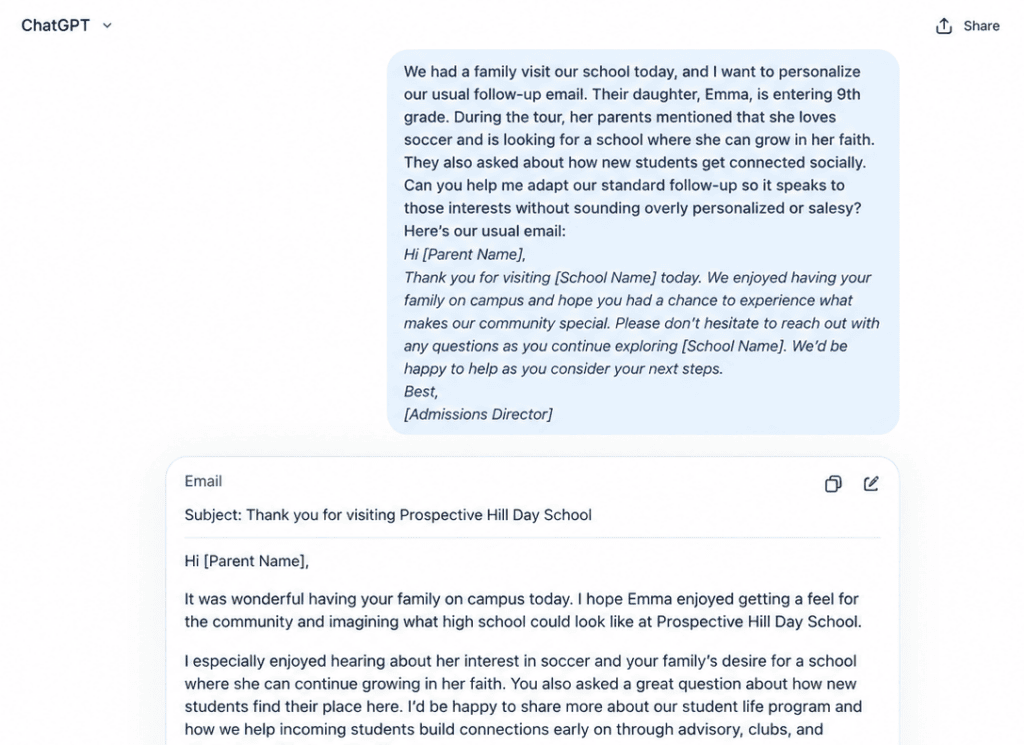
Your next step: Choose one admissions email your team sends frequently and identify where a little more family context could make it more relevant. Then give AI your existing message, examples of your school’s voice and details about the audience you’re trying to reach. Start with one repeatable communication and build from there.
4. Create more content without losing your school’s voice
Emails. Social posts. Website updates. Event promotions. Admissions materials. Follow-ups. Your school needs a steady stream of content, and the people responsible for creating it are often balancing plenty of other priorities. AI can certainly help you produce more. But producing more isn’t especially useful if everything starts sounding like it could have come from any school.
A better approach is to teach AI how your school communicates before asking it to create on your behalf. Give it examples of content that already sounds like you. Define your voice and tone. Tell it which messages matter most, what terminology your community uses and even which words or phrases you’d rather avoid. Those inputs give AI stronger guardrails for creating first drafts and repurposing content without starting from scratch.
Want AI-generated content to sound more like your school?
“Start by giving the AI strong inputs. Upload or paste a few recent, high-performing samples and ask it to analyze the voice, tone, and key messages. Then have it revise new content to match that style. Keep the human touch in the driver’s seat. Proofread for accuracy, warmth, and flow. AI tends to repeat certain phrases or default to generic wording, so a quick edit to add personality, clarity, and specific details keeps it sounding like your school.” — Angeline Gormley, Writer at Tassel
Shared guardrails can also help marketing and admissions work from the same playbook. When both teams use the same messaging and voice standards, an admissions follow-up and a marketing email are more likely to sound like they came from the same school. Your team can move faster without gradually creating two different versions of who you are.
Your next step: Before asking AI to create more content, give it better source material. Gather a few pieces that represent your school at its best, then document the voice, messages and language you want marketing and admissions to share. The clearer you are about what “sounds like us,” the more useful AI becomes
5. Help families find your school in AI-powered search
How prospective families search for schools is changing. Google is still part of the journey, but some parents are also turning to AI platforms to ask questions, compare options and get recommendations without ever scrolling through a traditional list of search results.
For schools, that introduces a new visibility question: When AI answers a prospective parent’s question, does your school show up? And is the information accurate?
Unlike the other examples we’ve covered, this use of AI isn’t primarily about helping your team complete a task. It’s about making sure AI platforms can understand your school well enough to include it in relevant answers.
That starts with the content you publish. Your website should clearly answer the questions prospective families are actually asking, with information structured in a way that search engines and AI platforms can understand. Schools should also pay attention to how they appear in AI-generated results. What information is being surfaced? What’s missing? Where could clearer or more useful website content help fill the gaps?
This emerging approach is often called AI-SEO. Tassel helps schools strengthen their visibility in AI-powered search by focusing their digital content on the questions and information prospective families are looking for.
Want to dig deeper into how AI is changing search? → Read our blog on AI-SEO for schools
Your next step: Try searching for your school the way a prospective parent might using an AI platform. Ask a few specific questions about schools like yours in your area and see what comes back. If your school is missing or misrepresented, you’ve found an opportunity to strengthen the content AI platforms have to work with.
5. Help families find your school in AI-powered search
You don’t need to adopt every AI tool that comes along. You just need to know where your enrollment strategy is getting stuck.
- Need more inquiries from the website traffic you already have? → Start with an AI-powered inquiry capture window, like Tassel Convert.
- Need prospective families to find you in AI-powered search? → Focus on AI-SEO.
- Need more consistency as your team creates content? → Connect with a Tassel solutions advisor to learn how a message workshop + AI tool can help you build stronger communication for your school.
Whatever you choose, measure AI against something that matters. Did it improve the family experience? Did it give your team meaningful time or capacity back?
The best AI investment is the one that helps solve a real enrollment problem.
Explore Tassel’s AI solutions for schools to see where AI could support your enrollment strategy.