
Headwind #2: When Team Readiness Slows Enrollment Progress
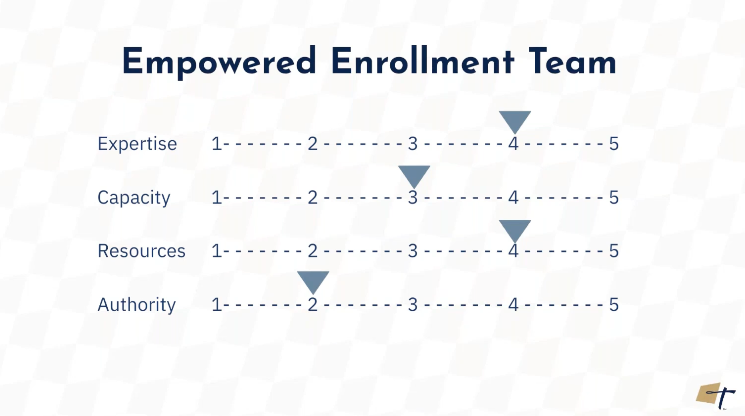
Empowered Enrollment Team
Your enrollment strategy may look solid on paper, but carrying it out feels harder than it should. Plans stall once they meet the day-to-day realities of enrollment work. Leaders hold responsibility without real leverage. Teams stay busy, but spend more time reacting than setting the pace. And over time, a quiet frustration settles in: the sense that goals are clear, effort is strong, and yet progress never fully takes hold.
This tension surfaced in The Four Headwinds Fighting Your Enrollment Team, a Tassel webinar featuring Andy Lynch, President & CEO at Tassel, alongside Rudi Gesch, Director of Marketing, and Dan Quist, Director of Admissions at Timothy Christian Schools. Together, they named the headwinds (or unseen forces) that work against enrollment teams, even when schools are doing many things right.
Just like Headwind #1 (Role Clarity), gaps in team readiness rarely stem from individual performance. They reflect the conditions teams are operating within, the support they’re given, the decisions they’re empowered to make, and the resources available to them.
Think of it this way:
- Clarity helps define who owns the work.
- Readiness determines whether the work can actually happen.
When readiness is stretched, even strong strategies become fragile. And that’s what brings us to Headwind #2: Team Readiness.
What We Mean by “Team Readiness”
When we talk about team readiness, we’re not talking about headcount. Readiness goes beyond having people filling needed roles to consider whether your enrollment team has what it needs to pursue your goals consistently and thoughtfully, without burning out in the process.
At Tassel, an empowered enrollment team is a core component to our healthy enrollment model. We define it as a team “with the expertise, capacity, resources, and authority to pursue enrollment goals and respond to seasonal priorities.” When those elements are in place, teams can plan ahead and keep strategy intact during busy cycles.
When one of those elements is missing, progress slows.
A gap in expertise can lead to second-guessing or over-reliance on tactics without a clear strategy behind them. Limited capacity makes even good plans feel impossible to execute. Under-resourced teams spend more time working around constraints than moving work forward. And without authority, responsibility increases while momentum fades.
Most enrollment teams aren’t weak across the board. In fact, many are quite strong in one or two of these areas. The challenge is that enrollment work depends on all four — expertise, capacity, resources, authority — working together. When one area is stretched, it creates drag on the rest, and the work starts to feel harder than it should.
The Four Elements of Team Readiness
There are four elements that impact enrollment work. Together, they form a practical lens for understanding what’s really shaping your team’s ability to move enrollment work forward.
Here’s what that looks like.
Expertise: knowing what to do and why it matters.
Teams with strong expertise understand enrollment strategy, not just tactics. They can make informed decisions, adapt when conditions change, and draw on learning, peers, and perspective beyond their own campus. Without that grounding, even well-intended effort can turn into guesswork.
Capacity: having time, margin, and headspace to do the work well.
Teams may have enough people on paper, but not enough headspace to think strategically or plan ahead. There’s a difference between sprinting during peak enrollment seasons and sprinting all year long (and many teams are stuck in the latter).
Resources: access to the tools, system, and budget that support enrollment goals.
When investment levels don’t match expectations, teams spend energy compensating instead of progressing. Under-resourcing enrollment work makes the work harder and less effective (not cheaper).
Authority: ability to make decisions, prioritize work, and act with trust.
This determines whether work can actually happen. When authority is unclear, enrollment leaders carry responsibility without real leverage, navigating approval loops that slow momentum and dilute focus.
Strength in one of these areas can’t fully compensate for gaps in another. But when they’re aligned, enrollment teams are far more likely to sustain strategy and make progress that lasts.
Take a moment and do this exercise: Now that you understand the four elements of Team Readiness, how would you rate your team in each area below? 1 is lacking and 5 is proficient.
Why Readiness Requires Leadership Support
When enrollment work struggles to gain traction, it’s tempting to look first at individuals. Is the team experienced enough? Organized enough? Pushing hard enough?
But enrollment teams don’t become empowered by accident, or even because the right individuals are in the right roles. Readiness reflects how enrollment is valued, supported, and prioritized at the leadership level. The conditions surrounding the work — what’s funded, what’s protected, what decisions can be made — send a much stronger signal than any strategic plan.
Teams can’t create readiness on their own. Expertise develops when learning is encouraged and resourced. Capacity exists when time and focus are intentionally protected. Resources appear when enrollment goals are treated as real commitments, not aspirational targets. Authority is granted when leadership trust is clear and decision-making lanes are defined.
All of that requires alignment. Enrollment is mission-critical, directly affecting the health, sustainability, and future of the school. Therefore, teams must be equipped accordingly. Otherwise, even strong leaders end up carrying unrealistic responsibilities.
Reflection: Where Is Our Team Ready, and Where Are We Stretched?
Don’t view team readiness as something to grade or diagnose from a distance, but as a starting point for clearer conversations about what’s working, what’s heavy, and what sort of support the work actually requires.
The questions below are meant to create awareness and are most useful when considered together, across roles and perspectives.
- Where do we feel strong as a team right now? What’s supporting momentum, clarity, or confidence in our enrollment work?
- Which of the four areas — expertise, capacity, resources, or authority — feels most constrained? Where does the work start to slow, even when priorities are clear?
- What assumptions are we making about what our team can handle? About time, pace, decision-making, or the complexity of the work itself?
- What would change if readiness were treated as a strategic priority? How might planning, resourcing, or leadership support look different?
Pausing to reflect on readiness creates space for better decisions, and to consider what conditions need to change for enrollment work to move forward in a healthier, more sustainable way.
What to Do Next
Team readiness is one of the foundational elements of Tassel’s Healthy Enrollment Model, because an empowered enrollment team is essential to sustainable, mission-aligned growth.
If you’re ready to explore how team readiness fits into a broader enrollment strategy, a Tassel solutions advisor would be glad to listen to the specific challenges you’re facing and help you pursue the next steps towards healthy enrollment.