
Headwind #1: When Everything Is Your Job, Nothing Is Strategic
Empowered Enrollment Team
Your email signature says you’re a marketing or enrollment director, but your calendar tells a different story.
You’re wearing more hats than you can count. You’ve become the default catch-all for anything that touches families, communication, visibility, or growth at your school. When something needs to be done and no one is quite sure where it belongs, it often lands on your desk.
And yet, for all the activity, the inbox-clearing, and the constant motion, there’s a quiet frustration underneath it all: you’re busy all the time, but rarely strategic.
That tension was the starting point for a Tassel webinar, The Four Headwinds Fighting Your Enrollment Team. In the session, Andy Lynch, President & CEO at Tassel, was joined by Rudi Gesch, Director of Marketing at Tassel, and Dan Quist, Director of Admissions at Timothy Christian Schools, to name and unpack the “headwinds” enrollment teams face, or the unseen forces that make this work harder than it needs to be.
They described headwinds not as personal shortcomings or performance gaps, but as structural challenges built into how enrollment work is often defined, supported, and resourced in schools.
This post is the first in a four-part series exploring those headwinds, starting with the one that tends to show up first and quietly shape everything that follows: a lack of role clarity.
What we mean by “Lack of Role Clarity”
When we talk about role clarity, we’re not talking about organizational charts or perfect job descriptions. At its core, role clarity is simple and deeply practical:
- Knowing what your job is
- Knowing what your job isn’t
- Having a shared understanding with leadership about where your responsibility begins and ends
Without that level of role clarity, even the most capable enrollment leaders end up stretched thin.
Most people working in marketing and enrollment never train for this work in the first place. Few schools have a clear, established blueprint for enrollment roles, which leads to team members being plunked into an office, handed a title, and expected to figure it out as they go.
Over time, job descriptions grow incrementally: a responsibility gets added here, a gap gets filled there, a temporary ask becomes permanent. If not careful, the role becomes a patchwork of inherited expectations, loosely connected by the phrase most enrollment leaders know all too well: other duties as assigned.
“That line has a way of doing a herculean amount of flexing in school environments,” noted Rudi. “It expands to include things that are important to the community, but not always aligned with the core purpose of the role. Each task on its own may seem reasonable, but collectively they chip away at the margin required for strategic enrollment work.”
That’s not to say you should be unwilling to help or resistant to collaboration. Schools thrive because people step in when needed. But when everything becomes part of your role, the work that actually grows enrollment — long-term strategy, family engagement, alignment with mission — gets pushed aside.
For a deeper look at these roles and where misalignment begins. explore Tassel’s breakdowns of the role of a school marketing director and the role of an admissions director
How role creep shows up in schools
Usually, role creep accumulates quietly, through reasonable requests and good intentions.
It can start with overlap. Marketing bleeds into admissions. Admissions bleeds into communications. Communications bleeds into event planning. Before long, you’re responsible not just for attracting families, but for every touchpoint they might encounter.
Then come the gaps: a coverage need, a supervision slot, a logistical problem that needs a reliable, competent person to step in. Because you’re already connected to “families” or “visibility,” those asks land with you. They’re temporary at first, then they become expected.
Overlay that with the daily reality of school life — the constant interruptions, urgent questions, last-minute decisions — and enrollment work starts to live entirely in reaction mode. Days fill up with what needs attention now, leaving little room for work that matters most.
“When enrollment leaders live only in urgency, the non-urgent work gets squeezed out,” explained Rudi.
Strategic planning and long-term growth are perpetually postponed because they lack immediacy, resulting in a familiar pattern: You’re working hard, but always behind. Busy, but rarely proactive. Helpful, but stretched thin. Over time, that strain shows up as burnout, frustration, and short tenures. Schools lose good, capable people because the role became unsustainable.
A Simple Reframe: Protecting the “Main Thing”
Your goal isn’t to find a way to do more or to do less, but to protect the main thing. For marketing and enrollment leaders, that main thing is clear, even when the role itself isn’t: growing enrollment with right-fit families. That’s the work that sustains a school’s mission, finances, and future. And it’s the work that requires the most clarity, intention, and margin.
The challenge is that without role clarity, the main thing is constantly crowded out by everything else. Important work competes with urgent work. Strategic priorities get delayed in favor of immediate needs. Over time, enrollment leaders end up spending their energy everywhere, and making progress nowhere.
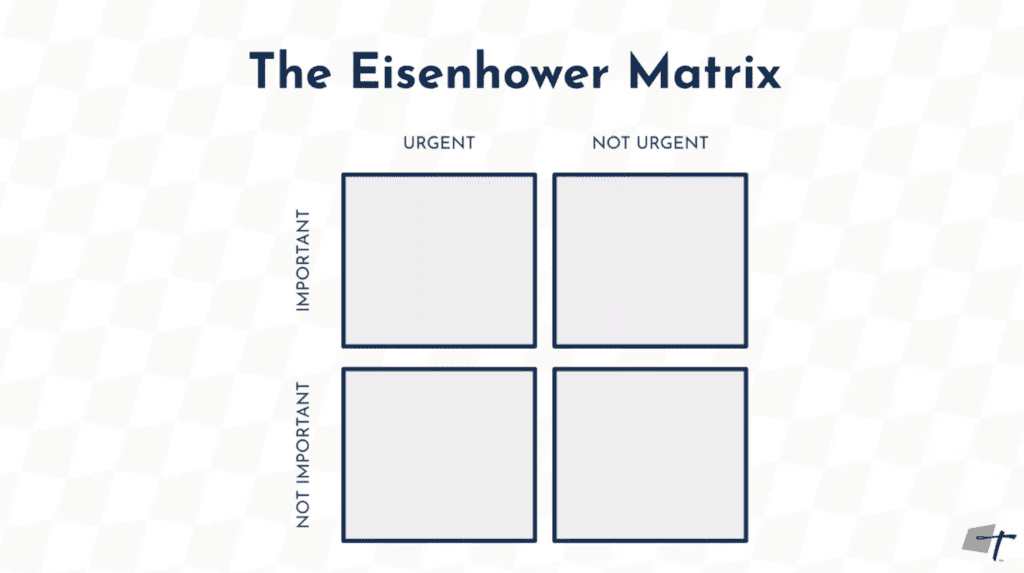
In The Four Headwinds webinar, this tension was illustrated using the Eisenhower Matrix as a way of naming what deserves protection.
Schools are full of urgent demands, and protecting the main thing often requires a shift in how we interpret helpfulness. Saying “yes” to everything may feel collaborative in the moment, but it quietly erodes the capacity needed for enrollment work that only you can do.
How the Eisenhower Matrix works
This simple framework can help clarify how work competes for your time, and is broken down into:
- Urgent and important — Work that needs immediate attention and directly supports enrollment outcomes. This work gets done.
- Important but not urgent — Strategic work that shapes long-term enrollment health (planning, alignment, goal-setting). This work must be intentionally scheduled, or it disappears.
- Urgent but not important — Tasks that feel pressing but don’t require your expertise. These are often candidates for delegation.
- Neither urgent nor important — Work that adds noise without advancing enrollment goals. This work can be removed.
Reflection: Questions to Take to Your Team or Leadership
If you’re running into the “lack of role clarity” headwind, it’s worth pausing to consider where role clarity is helping, and where it may be quietly working against you. These questions aren’t meant to be answered all at once, or in isolation. They’re conversation starters you can sit with personally, bring to your team, or use as a framework for dialogue with leadership.
- What outcomes am I ultimately responsible for, and where are those written down?
Are expectations clear and shared, or assumed and implied? - Which parts of my role directly support healthy enrollment?
Where is my time aligned with enrollment growth and right-fit families — and where is it drifting? - What work consistently pulls me away from strategic enrollment priorities?
Not occasional interruptions, but patterns that repeat year after year. - Where does leadership assume I have capacity that I don’t?
Where might parent volunteer help — or even 5 to 10 hours of professional part-time work — make a major difference in your strategic work? - If enrollment growth is critical to our school’s future, how is that reflected in my role?
In scope, authority, resourcing, and protection of time.
What to Do Next
Role clarity is one of the foundational elements of Tassel’s Healthy Enrollment Model, because an empowered enrollment team is essential to sustainable, mission-aligned growth. When roles are clear, protected, and supported, teams gain the margin they need to think strategically and lead enrollment work with confidence.
If you’re ready to explore how role clarity fits into a broader enrollment strategy, a Tassel solutions advisor would be glad to listen to the specific challenges you’re facing and help you pursue the next steps towards healthy enrollment.